
Why does every development look the same?
The truth is that a lot of housing and development projects are resisted because of how they look. But there's a reason we see the same things over-and-over across the U.S.
There’s a consistent gripe I hear from people who point to housing projects in their town. Whether they are for or against it — they tend to absolutely hate the designs.
Too boxy. Too bland. Sometimes too colorful. Too modern. Too sterile. Too corporate-looking.
And honestly? They’re not wrong.
Over the weekend I was talking with a friend who works at an out-of-state architecture firm. He previously worked in New York, and we ended up talking about the now-ubiquitous “5-over-1” apartment buildings that make up for most housing development projects.
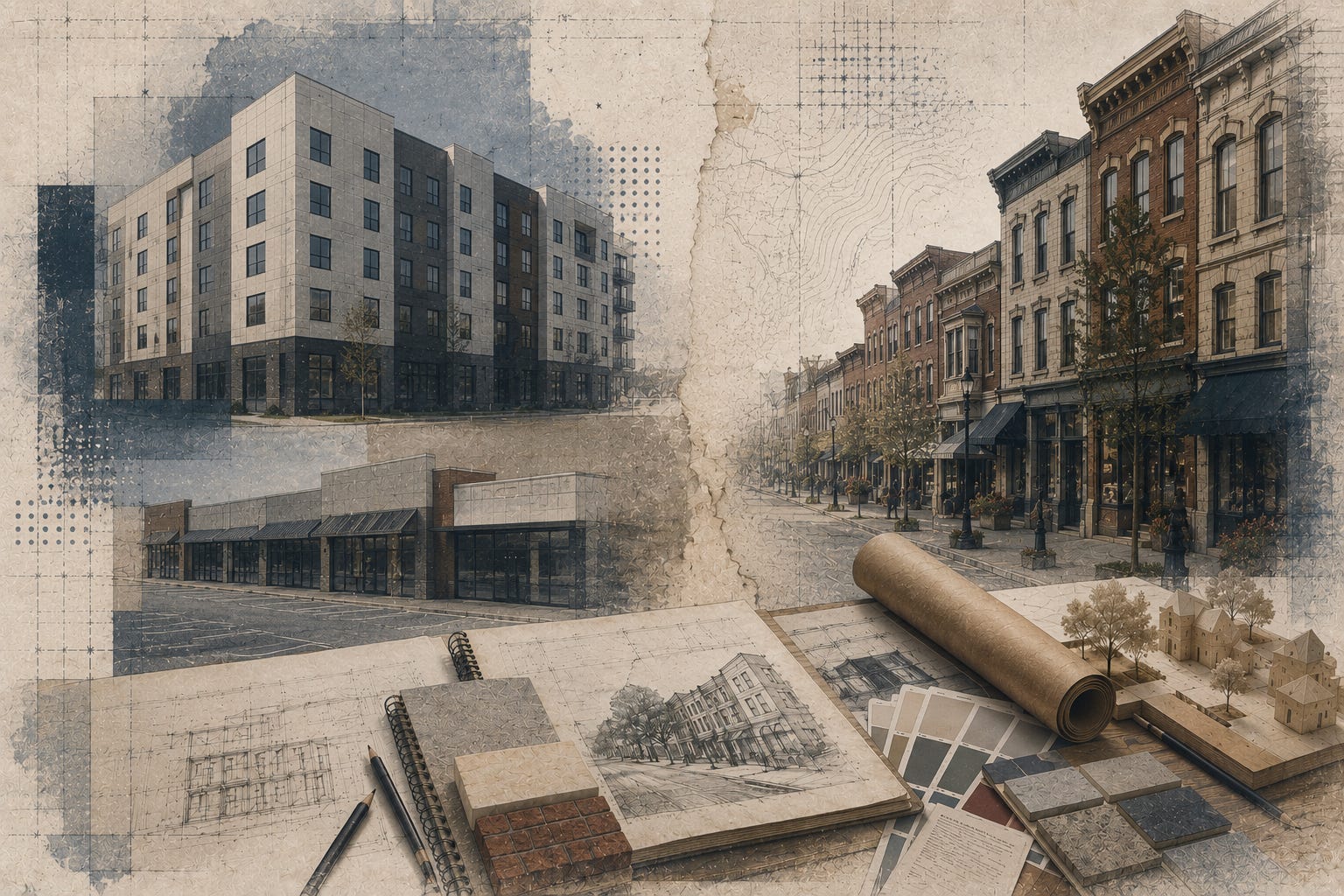
You might not know them by name — but you most certainly have seen them. Rectangles stacked on rectangles. Panels. Flat lines. Repetitive façades. Buildings people roll their eyes at when the renderings hit Facebook.
They don’t go by the exact same name, but this design methodology applies to commercial developments, too. Take a look at any recent chain fast food restaurant or strip mall. Rectangles and panels everywhere.
The reality here is that communities keep approving them because they solve a very practical problem. They’re efficient to build. They’re cost-effective compared to more elaborate designs. And at a time when communities are starved for development — housing or commercial — “better than nothing” carries a lot of weight.
But my friend raised a point I haven’t stopped thinking about since.
We quickly found ourselves talking about a book I wrote about earlier this year by Dan Wang called “Breakneck: China’s Quest to Engineer the Future.” Stripping politics out of it, the book explores a straightforward idea: What happens when societies are shaped primarily by engineers instead of lawyers? China’s rise, Wang argues, was driven largely by engineering minds, while the United States increasingly evolved under legal and regulatory thinking.
My friend started talking about the internal conversations that happen at architecture firms today. Not just around cost. Not just around engineering feasibility. Around liability. Around litigation exposure. Around minimizing the chance that somebody, somewhere, could someday sue over something.
And if that sounds vague, that’s the point. We’re not even talking about catastrophic failures. We’re talking about designing around the possibility that almost anything could become a lawsuit someday.
We’re talking about water intrusion. Drainage details. Material transitions. Exterior features. Small elements that introduce complexity, which in turn introduces risk.
He mentioned several recent projects where architects or clients had discussed ideas that would have made buildings more visually interesting. Some were modest improvements. Some apparently looked fantastic. But all of them either got scaled back almost nothing or eliminated entirely because the risk calculation changed.
Not because the ideas were impossible or bad. Because nobody wants to be the next lawsuit.
That’s the part of the housing and development conversation people rarely talk about publicly. People frame every issue through the lens of zoning, NIMBYism, regulation, or profit maximization. And yes, those are absolutely big parts of the conversation.
But fear of litigation is also shaping the physical world around us. And that’s not good.
It’s fear of liability. Fear of making the wrong decision. Fear of deviating from the safest possible template.
And once an entire industry begins optimizing around minimizing risk above all else, you inevitably start producing environments that feel lifeless.
That’s how you end up with architecture that increasingly feels computer-generated. Safe. Repetitive. Technically functional, but emotionally empty. It’s hard to generate human buy-in that way.
People love historic buildings because historic buildings feel human. They have quirks. Character, imperfections, weird details, risk-taking, and even [gasp] personality.
And yes, part of that existed decades ago because there were fewer rules, fewer regulations, and fewer opportunities for litigation. That didn’t mean everything was perfect. Far from it. Some projects failed spectacularly. Mistakes happened constantly. Corners were cut. Buildings aged poorly. And some were straight-up unsafe.
But collectively, those environments still managed to produce places people actually enjoyed being in and could support.
Today, we’ve built a system obsessed with perfection on paper. Every detail scrutinized. Every contingency analyzed. Every stakeholder empowered to object. Every project lawyered into submission before a shovel even touches dirt.
Then we wonder why everything looks the same.
I’ve written plenty about the resistance communities throw up against housing development. I’ve also written about the regulatory maze that exists for anybody trying to build almost anything in New York. But I don’t think we spend enough time talking about what risk aversion itself has done to development culture.
Because this matters far beyond architecture.
The same mentality now infects local government, infrastructure planning, housing policy, environmental review, energy development, and economic growth generally. We increasingly operate in systems designed not to achieve great outcomes, but to avoid bad headlines, complaints, backlash, or most importantly — lawsuits.
That sounds reasonable until you realize it creates paralysis. You can’t simultaneously demand innovation while punishing every imperfect outcome.
You can’t ask for bold ideas while building systems that financially and legally destroy people for taking risks.
And you can’t keep layering process upon process upon process onto development, then act surprised when the only projects capable of surviving are the most standardized, risk-minimized versions possible.
If communities genuinely want different outcomes — more housing, more creativity, more ambitious development, more interesting public spaces — then at some point the broader framework itself has to change.
Because right now, the system isn’t producing accidental results. It’s producing the kind of results it was designed to create.